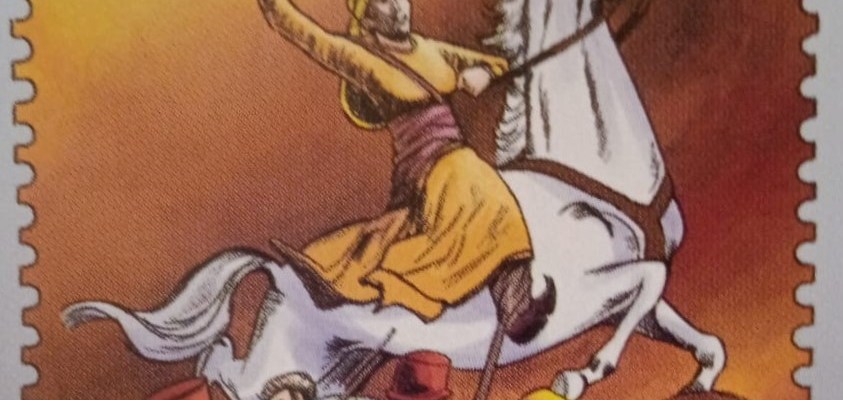
Jhalkari Bai
On 22nd November 1830, in a small village called Bhojla, near Jhansi, a little girl was born to a Kori (Kori is a community of people who were traditionally weavers, but Sadova Singh was a farmer) couple, Sadova Singh and his wife Jamuna Devi. They named her Jhalkari.
As the only child of indulgent parents, Jhalkari grew up with an independent spirit. She disliked anything that was feminine, anything that suited girls, as a child. Her father constantly encouraged her to grow in the manner she desired. However, Jhalkari’s carefree days were ended prematurely when her mother passed away unexpectedly. The little girl had to get busy learning chores. Her father bought her a bow and arrow made especially for her and then took her to practice. He taught her how to fight using the Latis, wooden sticks, swords, and even a bow and arrow. She vigorously practiced, until she achieved perfection. Jhalkari was 12 years old when she went too far into the forest to cut wood and was attacked by a wolf. Jhalkari swung her axe at the wolf, but she lost her grip on the handle. According to legend, the young girl fought the wolf and killed it with her bare hands. Jhalkari’s talent and bravery developed greatly with time. When she was attacked by a leopard in the bush, she killed it. And everyone was impressed by the girl’s extraordinary adventures and bravery. One day, there were dacoits in her neighbourhood, and when she heard people screaming for help in the middle of the night, Jhalkari hurried to the neighbor’s house where the dacoits had broken in and took control. As she smacked them black and blue, the robbers took to their heels.
Puran Kori, a soldier from Narayanpura who fought in Rani Lakshmi Bai’s army’s artillery regiment, heard about Jhalkari’s bravery. He told his mother, “It sounds like an amazing lady. Jhalkari is the girl I’m going to marry.” Jhalkari’s father accepted Puran’s proposal, and the couple were married in a small traditional ceremony soon after. Puran and Jhalkari were happy together because they shared so many common interests. They went horse racing together. And one day, he had the bright idea of bringing her to meet Rani Lakshmi Bai. He took her to the palace on the eve of Shivaratri. There was a large audience gathered in the court. Everyone in attendance paid their respects to Rani Lakshmi Bai one by one. Jhansi Lakshmi Bai was shocked to see Jhalkari when it was Puran and Jhalkari’s turn. She stated. “What a marvel! You have a striking resemblance to me.” Jhalkari began to spend time with the queen, and they became acquaintances since they shared a passion for hunting and shooting. The queen then began to entirely confide in Jhalkari and began to rely on her. She even encouraged Jhalkari to organize a female army. Jhalkari began her training immediately.
The British were well established in India, and the people were reeling under their rule. Anger against the British was heating up. The Indian War of Independence of 1857 began on May 10, 1857, with a revolt of Sepoys in Meerut. The rebellion quickly extended to Jhansi. Mutinies broke out in Delhi, Lucknow, Kanpur, and other cities during the next few months. General Hugh Rose was charged with putting an end to the revolt as the Central India Force’s commander. Then, all of a sudden, they prepare to surround Jhansi and capture their queen. On March 23, 1858, General Rose launched an attack on Jhansi with a large army. The Queen had bravely fought the enemy with 4000 troops. However, Jhansi’s forces were outnumbered. It was clear that Jhansi was losing the battle. They waited for Peshwa Nana Saheb’s army to arrive. However, it kept delayed. Another piece of terrible news was that Tantya Tope’s troops had been defeated by General Rose. As a result, the assistance did not arrive as planned. It is now a dangerous situation. The Queen was holding an emergency War Council meeting. When Jhalkari had an idea, she told the Queen that because our men were decreasing and our food supplies were running low, if the enemy forces penetrated the fort’s walls, we would be compelled to engage in hand-to-hand warfare within the fort. We don’t want any risk to come our way in this situation. So, they were devising a strategy. What may possibly be done? And she proposed a plan to deceive the enemy. She would disguise herself as “Maharani” and lead a small unit of soldiers from the fort’s entrance. In the meantime, Rani is able to flee from the other side of the fort. Once she’s in a safe place, she has the ability to reassemble her armies and assault the British once more. It was a courageous suggestion in a time of need. Preparations for carrying out their plan began. She and the troops entered through the front door. Rani Lakshmi Bai seized the opportunity presented by the uncertainty and chaos.
Jhalkari made her way past the enemy ranks to General Rose’s camp. She fought valiantly for an entire day without anyone discovering her true identity. But the pretense couldn’t last long. Jhalkari was captured and handed over to General Rose. Jhalkari was under constant surveillance. Jhalkari, however, was not the one who was stopped that night. General Rose was surprised to see Jhalkari in the fort when he began an attack at dawn. A fierce battle ensued. Jhalkari and her soldiers had just successfully reduced the enemy’s number. When Jhalkari learned that Puran had been martyred, she battled with new vigor, not letting his sacrifice go in vain. British troops began to target her. A few more shots struck her as she collapsed. Jhalkari died, sacrificing her life for the queen and the land she loved so much.
While the contribution of Jhalkari was unknown till it was brought to light in the 1960s by historians. Today, she is a symbol of pride not just for her community, but for the entire nation. Over the years, her greatness has been celebrated through plays, stories, and songs, and she’s revered as Veerangana, or brave Jhalkari. The statue built in her honor and the Veerangana Memorial Trust in Bundelkhand have kept the legend of Jhalkari alive. Even today, she serves as an inspiration to young girls throughout the country. The Government of India honoured the warrior by releasing a postal stamp depicting Jhalkari Bai.
