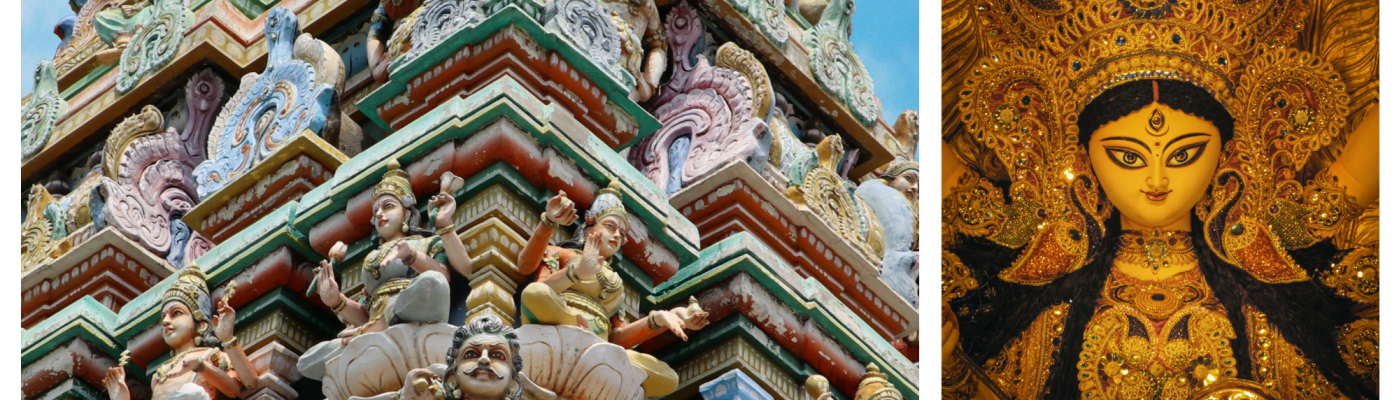
Tilak
A tilak is considered auspicious. A mark on the forehead is worn by young girls and women in India. It is applied on the forehead with Kumkum, sacred ashes, or sandal paste (red turmeric). According to Hindu belief, Aagnya, also known as the brow or third eye chakra, is the sixth main chakra in the body and represents the subconscious mind, which has a direct connection to Brahman (ultimate reality). According to tradition, the third eye helps people connect to their intuition.
Cows are worshipped
The cow is crucial to Hinduism because they are unable to perform sacrifices without ghee, which is a dairy product manufactured from cow’s milk.
Hindu herbal medicines frequently contain ghee as a key component. It is a variety of butter that is higher in nutrients than other varieties and a rich source of vitamins A, C, and D, and Hinduism acknowledges that cows serve as surrogate mothers by giving humans milk throughout their lifetime. Cow dung can be used as an efficient disinfectant, natural mosquito repellent, and potent fertilizer that will increase agricultural productivity. Hindus never consume beef. It is a sin for Hindus.
Temple Architecture and the Science Behind
The Shilpa Shastra, a collection of ancient Indian scriptures, served as the basis for the discipline of temple dimensions. Simply put, the concept employs the human body and its chakras as a guide for where to arrange the various parts in the temple. Each of these chakras, or energy levels, is linked with the magnetism level at that point.
We feel calmer and calmer as we move gradually past each element and towards the garbhagriha, the core center of the temple, which represents the agnya chakra, which is situated between your eyebrows.
Chanting OM or mantras
Focus and perspective are simple to achieve when chanting mantras because, in general, it is believed that they create brain vibrations. People’s brains showed precisely synced waveforms with perfect symmetry when they were instructed to repeatedly say the “OM” mantra. Mantra chanting is an ancient practise for calming the mind. In other words, you can use the mantra to control your mind and reach the ‘deep meditation’ state known as ‘samadhi.’ As a result, you will achieve spiritual realization, such as knowing yourself.
Chanting OM – Benefits
One’s concentration is improved by it. It lessens anxiety and provides stress relief, revitalizes the body and calms the anxious heart. The vibrations enhance the efficiency of the spinal cord and spread great vibes. It makes the heart and digestive system perform better. This wonderful melody promotes mental tranquility and emotional stability in one’s life. It ensures a restful slumber. This power enhances logic and lessens unfavourable negative energy.
Atiti Devo Bhava
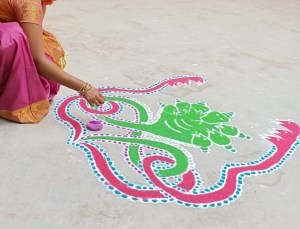
Atithi Devo Bhava in Hindu tradition means Guests are God. Whenever a guest visits, it is a time of happiness. Atithi Devo Bhava depicts the warmth and hospitality shown to guests by Indian hosts. Atithi is someone who arrives unexpectedly and can stay for as long as they desire; it is essential to meet their needs and provide them with the best stay possible. We offer our guests preferential treatment, which is known as Atithi Satkar. In India, the hosts give a lot of emphasis on providing the greatest facilities. Guests must be welcomed with kindness, love, affection, and care. One of the reasons why Indians draw Rangoli is that when guests enter the house with beautiful drawings, their spirits are lifted and they receive a warm welcome.
Spicy Food and eating with our hands
The Indian cooking and eating process is a great combination of science and discipline. Apart from enhancing flavour, the spices have numerous health benefits such as antimicrobial qualities, and anti-inflammatory actions that improve heart health and digestion.
Eating, according to Ayurveda, should involve all of the senses. As a result, in India, we mostly eat with our hands. The nerve endings on our fingertips are linked to our digestive system. When they come into contact with food, they stimulate the gastric system and activate digestive juices. Thus, eating with one’s hands helps digestion.
Idol worshipping
Idol worship is common in Hindu culture, and it was also prevalent during the Vedic period. Idols are a simple approach to illustrating complex ideas.
Humans can find it difficult to recall God in his non-physical form, which is why worshipping idols has been a means to concentrate and connect with God more closely, using the physical form to connect with the divine.
Furthermore, there is a scientific explanation for idol worship, statue construction, and temple construction in Hindu culture. An idol is energized in a way that it emanates vibrations that can impact individuals inside the temple. This process of revitalizing and giving life to an idol is known as “Prana Prathista,” or idol consecration, and it culminates in a positive vibe and aura surrounding it. A temple, similarly, is a place where an energized God resides, which is why it is considered to be a place where one can sit and be peaceful.
Arranged Marriages
The low divorce rates among arranged marriage couples suggest that following customs and relying on one’s parents’ judgement is beneficial. Marriages arranged by parents and families are not always based on the young couple’s whims. As a result, there are no impulsive marriages and, as a result, no awful divorces. Equality in education, finances, and world views. Because families do the pairing, they want partners of the same stature. This puts the relationship on an equal footing and allows things to progress from there. Marriage does not imply that you have married each other. You marry each other’s families and fulfill your responsibilities towards them. According to a study, those in arranged marriages—or those who have had their partner picked for them by a parent or matchmaker—tend to feel more in love as time passes, but those in regular marriages tend to feel less in love as time passes. According to relationship specialists, this is because arranged marriages are thoroughly researched, with consideration given to whether possible partners’ families, interests, and life objectives are compatible.
Joint Families
The beauty of Indian culture is found in its age-old tradition of the joint family system. It is a system in which even extended family members, such as parents, children, children’s spouses and offspring, and so on, live together. In a joint family, the value system plays an enormous role. The elderly upholds certain principles, which kids might naturally inherit. Children absorb the lessons of ethics and morals from their elders. A joint family home is full of people who love and support you, giving you the strength to pursue your goals. A joint family strengthens emotional bonds and teaches members to share. One of the ground rules in a joint family system is that financial expenses should be shared equally by all members. The financial burden is reduced since everyone contributes. Growing up in a joint household, children learn the division of labour and how to cooperate to attain a common goal.
