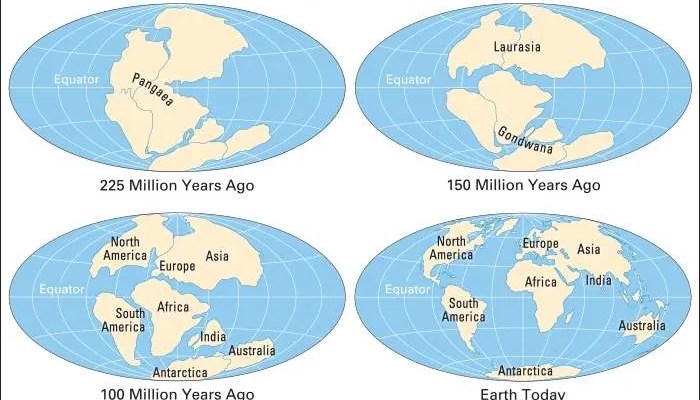
Pangaea, often known as Pangea, was a massive, contiguous landmass that existed around 335 million years ago. There was no human life on Pangea. Other species, such as dinosaurs, could have lived on this vast expanse. Around 200 million years ago, towards the conclusion of the Triassic and the start of the Jurassic, it started to disintegrate. Plate tectonics caused the enormous continent to split into Laurasia and Gondwana. The modern earth was formed as the two continents continued to separate. One of the landmasses drifted northward throughout the Millennium until it collided with Laurasia. This powerful collision gave rise to the Himalayas and so India was formed.
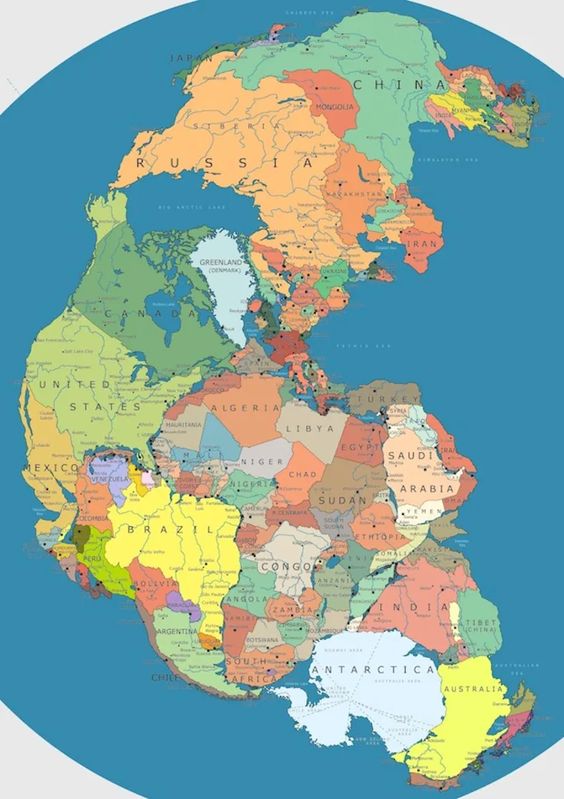
Have you ever wondered what Pangea might look like with current borders? The continent map above depicts Pangea as it might appear if today’s country lines were in place. The “Pangea Politico” is so named because it depicts today’s political borders. Massimo Pietrobon, an Italian cartographer, created the map.
/*! elementor – v3.7.8 – 02-10-2022 */
.elementor-widget-image{text-align:center}.elementor-widget-image a{display:inline-block}.elementor-widget-image a img[src$=”.svg”]{width:48px}.elementor-widget-image img{vertical-align:middle;display:inline-block}
The magnificent Himalayan mountains that we see today were once under the sea. This is why sea fossils are regularly found at the top of the range. The Himalayas were once submerged in an ocean known as the Tethys Ocean.
The Himalayan mountain range and Tibetan plateau were produced by the collision of the Indian Plate with the Eurasian Plate, which began 50 million years ago and continues to.
India was a vast island off the coast of Australia, separated from Asia by the Tethys Ocean 225 million years ago (Ma).
Geographically speaking, India is a peninsula because it is bordered by water on three sides. The vast Himalayan range, with all of its magnificence and beauty, is located in the north. These mountains give rise to the three major rivers—the Indus, Brahmaputra, and Ganga—that irrigate the northern plains. Our civilization would develop in these regions. The ghats are historic hills that dot the landscape in the south. The Narmada, Tungabhadra, Godavari, Krishna, and Kaveri are rivers in the south.
India is a huge nation with a diverse landscape that includes plains, mangroves, islands, deserts, and the arctic Himalayas.
