I decided to spend my maternity leave at my grandmother’s place, Raichur, where I was born and brought up. So, there I was, with her and I truly treasure every moment
I spent with my grandmother. My grandma asked if she could put to practice all the age-old Ayurvedic practices they had back in the good old days. I was really excited about it. It was such a royal retreat.
Uncovering the bundle of herbs every day was a marvelous experience. I believe that somewhere along the way, in our rush to imitate the West, in our rush to move forward quickly and furiously, we lost touch with our purpose, lost sight of what was most important. I take the privilege of walking you through an enchanting experience that once existed as a common household practice. You will feel blessed with such a soulful experience, something that will teach you more about bonding and wisdom. The post-natal care, the Ayurvedic way, the Sanskaras, has been there with our mothers, grandmothers, and generations altogether and will be wiped out soon if our generation misses out on putting it to use. The three-month maternity leave that I had was so worth engaging in a worthwhile pursuit. I could feel the ancient wisdom to enjoy the journey and savour the process. So, this is just an attempt to bring back the essence of life. It has a profound influence on the quality of life every day. I noticed my days unfolded in a marvelous way. It gave me a chance to refocus on the relationships around me, my grandmother, my doddamma (Maternal Aunt), my mother, and, of course, my daughter, the newborn, all women. How all these beautiful women made it so special for the warm welcome of the newborn. We literally celebrated every day. In India, you have more female friends and relatives visiting you to see the newborn.
I’m curious about how people became so civilized and learned so much about ancient Ayurvedic practices. They never attended school. Probably in olden days, people were intellectually curious, rigorous in their pursuit of knowledge. It was most likely passed through intuition. Like Albert Einstein said, “The intuitive mind is a sacred gift, and the rational mind is a faithful servant. We have created a society that honors the servant and has forgotten the gift.”
So here is the post natal care routine:
Massage & herbal bath
It is said that the first 45 days are quite important for a Sutika (a woman who has just given birth) until the reappearance of menstruation. The oil massage is followed by an herbal bath using a paste made of chickpea flour mixed with milk cream. It acts as a moisturizer and helps reduce stretch marks.
Smoke therapy & Hot Fomentation
After bath smoke therapy with dhoop is recommended. The hot fermentaion
therapy is the next therapy recommended.
Method : A traditional bed (khaat), made of ropes, is said to be the most suitable for the treatment. A metal container with hot charcoal embers is then placed under the bed. Everyday the hot fomentation is done for 10-15 minutes , after which specific herbs should be added to these charcoal embers and spread the smoke to the entire body. Some of the herbs which can be used are balantshop (Peucedanum graveleons), ova(carom copticum), vavading(Embelia ribes), Santulan shakti dhoop, etc.
The heat should be felt all over the body, especially at the waist. Hot fomentation helps pacify vata and restores strength to the joints. Thus it helps in preventing back ache. If charcoal is not available , hot bags or electric heating pads can be used instead and a heater to warm the room. During Summer as much fomentation should be taken as much can be tolerated.
Covering the ears
Ears should be covered with a small cotton ball and scarf during the 45 post delivery. Ears should not be exposed to the air of a fan or air-conditioner.
Abdominal belt
A waist belt needs to be tied securely around the abdomen immediately after delivery and needs to be followed everyday and this should remain in position day and night
except when having a bath. This helps to restore the waist to its earlier girth. It also prevents flatulence and satisfaction after meals, which reduces the risk of overeating.
Abhyang, pichu and padabhyang is suggested.
Diet after delivery
The mother who breastfeeds her baby should carefully plan her diet, to maintain the good health of both her and the child.
Balguti
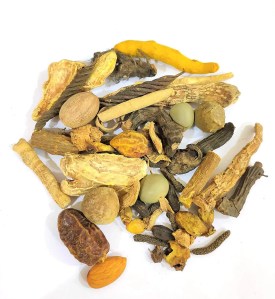
Traditionally it is common to give Balguti to infants every day. The herbs that make up the Balguti are to be ground in Mothers milk or in gold water(Survarnajal- water boiled and infused with gold) and should be given to the baby once a day. Balguti is started once the baby is 10 days old and continued uptil the baby is fifteen months old.
The different herbs used and their benefits:
I am briefing about few herbs
Murudsheng (Helicteres isora): Helps reduce cramps and parasitic infestations.
Hirda (Terminalia Chebula): Stimulates the appetite and liver function, improves digestion, facilitates the passage of wind, improves bowel movements, helps eliminate worms.
Pimpli (Piper Longum): Long pepper, mainly used for respiratory and digestion problems. Prevents cough and cold, improves digestion.
Jaiphal: Nutmeg, helps baby sleep better. It improves babys memory, cognitive capabilities. Stool consistency is another benefit, used to treat loose motions.
Vekhand (Acorus calamus): Helps improve comprehension, intelligence, clarity of speech in children.
